©2026 Compass Learning Technologies ← Exploring Stern-Brocot → Introducing the Stern Diatonic Sequence/Fusc Function
Introducing the Stern Diatonic Sequence/Fusc Function:
From Integer Sequence to Fraction Trees
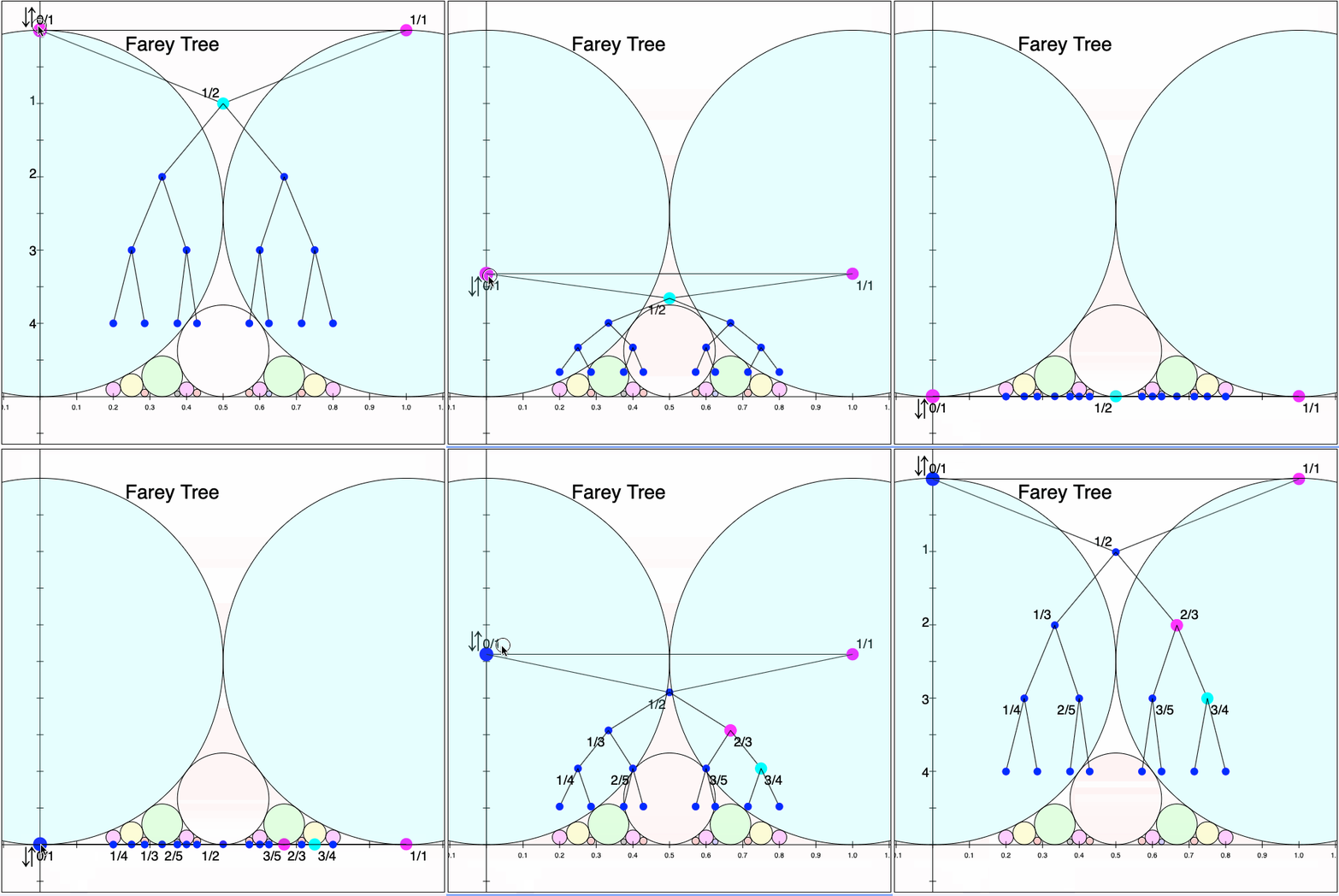
Suppose you wanted to make a list of all the rationals... How might you start?
One approach might be to begin with the denominators of the fractions: first, list those with denominator 1 - zero and 1: \(\frac{0}{1}, \frac{1}{1} \).
Next, add those with denominator 2: \(\frac{0}{1}, \frac{1}{2}, \frac{1}{1} \).
Add those with denominator 3 (\(\frac{0}{1}, \frac{1}{3}, \frac{1}{2}, \frac{2}{3}, \frac{1}{1} \)) and you are on your way to the Farey Sequence! This last would be referred to as the Farey Sequence of Order 3.
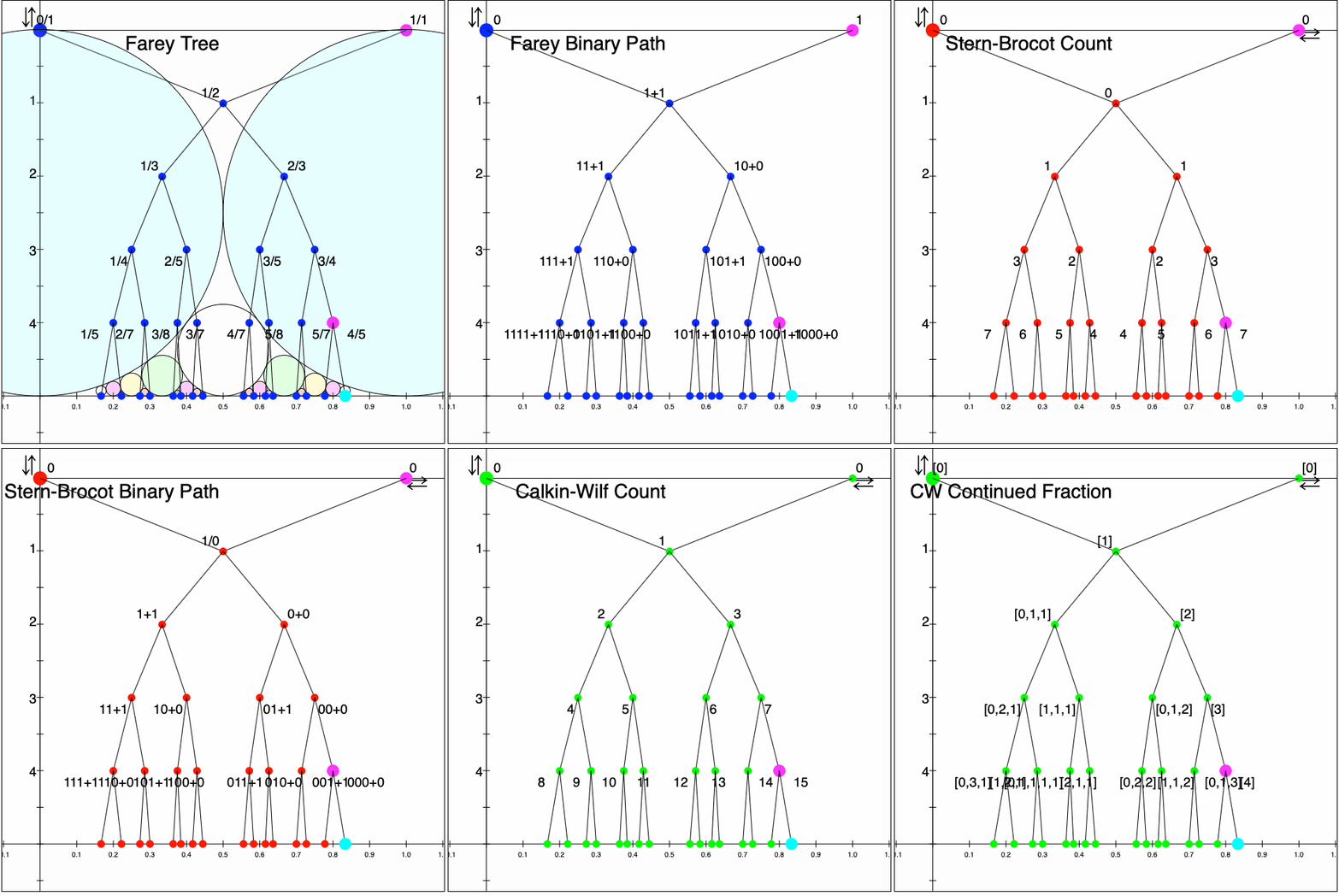
The Farey Tree (or the Stern-Brocot Tree Left Branch) generates all the rationals between 0 and 1, and forms the basis for both Stern-Brocot and Calkin-Wilf Trees. These trees take each level of the Farey Tree, add mirrored reciprocals of each term, and then just arrange them differently - Stern-Brocot in increasing order, and Calkin-Wilf interleaving the two sets of terms.
Various methods have been found to generate the terms of these trees, from Stern's Diatomic Fibonacci-like integer Sequence described here, to the unique Stern-Brocot Continued Fraction described by Dr Bruce Bates from the University of Wollongong in 2014.
GXWeb Mathematical ToolKit